Education & Children's Books
Books, Tapes and Movies for Children
- Birth to One Year
- One Years Old
- Two Years Old
- Three Years Old
- Four to Six Years Old
- Seven to Nine
- Ten to Twelve
- Thirteen to Fifteen
Books about Children and Education
These books cover educational theory and practice from birth through early teen years. (For subsequent education see the StrongBrains home page.) Two of the books below provide extensive lists of additional books. These are Babies Need Books and The Well-Trained Mind.
Birth through Age Six
First, a word about Montessori education, since this will come up by the time your child is three: Montessori is the best program. But, there is no quality control enforcement governing which schools can call themselves "Montessori" and they range from good to rotten. To evaluate a school, you need to have a clear grasp of the educational philosophy and methods of Maria Montessori (several of her books are listed below) and compare your observations of candidate schools against this standard.
If you contemplate home-schooling your child between three and six, consider a Montessori school as an alternative. I deem the widespread need for home-schooling an unfortunate necessity driven by the bad ideas and methods that make most public and private schools positively harmful to children. However, between the ages of three and six, you may be fortunate and find a good, Montessori school. If so, you can take advantage of its specialized teachers and materials. If you have several children, dividing the load between a Montessori school and home schooling will allow you more concentration. You won't have this option much after age six when your child becomes more conceptual and Montessori methods less appropriate, but you have it now.
For a quick, video overview of the energizing power of Montessori, see Montessori Madness.
About Child Development
- Baby Human, Geniuses in Diapers. This video shows the amazing cognitive development of baby humans, how incredibly thoughtful they are of the world around them, and how they learn through active engagement of the world.
- Your Baby and Child by . Sensible and comprehensive advice on the physical and mental care of babies and their parents.
- The First Twelve Months of Life by . Developmental milestones and guidance for helping your child during their first year.
- How to Raise a Brighter Child by . The joys of having an intelligent, self-confident child and the actions you can take to promote that. "Beck holds that if parents recognize and try to satisfy a child's intellectual needs during the earliest years of life, any child, whatever his innate ability, can become brighter, more capable, more independent and consequently happier. ... It is an excellent guide-book -- a blueprint for introducing eager young minds to the pleasures of learning, thinking and creating." --The Objectivist
- Childhood as It Should Have Been and Ought to Be by . (audio) Parenting skills for raising rational, happy kids.
- Babies Need Books, Sharing the Joy of Books with Children from Birth to Six by . An empassioned argument that children need to read and be read to. Excellent guidance and booklists for which books are appropriate for each stage of a child's growth.
- Montessori Play and Learn, A Parents Guide to Purposeful Play from Two to Six by . A concise introduction to the history and key ideas of the Montessori method, with many practical ideas for helping children develop their minds, skills and independence.
- The Absorbent Mind by . Children love to use their minds. The natural function of a child is to grow into an independent, confident, adult human. Adults can help by respecting that the child is not yet an adult, so needs educational material appropriate for his stages of development, material that allows him to concentrate and discover. Because an adult human is not just an adult animal, but a conceptual being, the child needs to be taught the material of organized, rational thought.
- Dr. Montessori's Own Handbook by . Specific instruction on using the ingenious educational toys developed by Dr. Montessori.
- The Montessori Method by . More detailed and theoretical than the later The Absorbent Mind, this explains the thinking behind Montessori's radical educational approach and deepens one understanding of it.
- Turning Back the Tide of Illiteracy by . The theory and practice of Phonics, traning in both reading and thinking skills.
- Why Johnny Can't Read by . A criticism of the "look-say" and other anti-phonics approaches to reading instruction. Also contains a full program of Phonics. (Phonics is the conceptual approach to reading, teaching the sounds of individual letters and their combinations.)
- Between Parent and Child, New Solutions to Old Problems by . How to respect the emotional needs of others, particularly children, and work with them non-destructively.
- Parents Magazine. Generally sensible advice for parents
Music, Video, Language and Stories
Specific books, audio tapes and videos for children are listed on pages linked from the section at the top of this page. Here I just make some general notes about suitability and language skills.
The important aspect of music and video material is that it should be appropriate to a child's level of comprehension and reflect an orderly, rational world of solid, determinate, stable, understandable and predictable objects. Avoid material that is chaotic, switches context too rapidly to follow easily, is raucous, overtly stupid or predominantly violent.
Regarding language sensitivity, exposure to several languages while very young will develop a life-long capacity to hear those sounds correctly. Several of the recordings below provide language exposure. In addition to these, many children's DVDs from Disney contain French and Spanish tracks. If you play these videos consistenly in either French or Spanish from a young age, your child will likely accept that they are simply that way. I favor the Disney movies, for example:
- 101 Dalmations by . Pongo and Perdita, two dalmations, bravely save their puppies from the schemes of a wild villianess. (ages 3 to 4)
- Peter Pan by . Swashbuckling Peter Pan leads Wendy, John and Michael on brave adventures, overcoming the schemes of Captain Hook, the jealosy of Tinker Bell and even a band of pre-political-correctness Indians. (ages 3 to 4)
- The Jungle Book by . Mowgli, the man-cub, raised by wolves in the jungle of India, has upbeat adventures with friends while defeating those who assault him. Great jazz soundtrack. (ages 3 to 4)
- A Bug's Life by . Flick, the optimistic and inventive hero, repeatedly finds the courage to outwit and outlast his enemies, eventually triumphing over all and saving those he loves. (ages 3 to 4)
- Toy Story by . Woody overcomes his jealosy and Buzz Lightyear his delusions when they realize that the values they hold in common are more important than their rivalry. (ages 3 to 13)
- Toy Story 2 by . Woody discovers that a finite life full of values is better than a value-empty immortality. (ages 3 to 13)
- Rattatouille by . An animated rat pursues and achieves the career he loves. (ages 10 to 16)
See also Video Review.
Ages Six through Adult
- Between Parent and Teenager by . Continuation of the ideas in Between Parent and Child, now focussed on the teenage years.
- Reclaiming Education, The Home-Schooling Alternative by Lisa Van Damme. An inspiring lecture on the achievements possible to children given a focussed, rational education. Audio.
- Teaching Johnny to Think by Leonard Peikoff. This book, based on a lecture series, identifies the central purpose, method and curriculum of a proper education.
- The Well-Trained Mind, A Guide to Classical Education at Home by . A classical education based on the trivium respects a child's developing capacities and is rich in the core subjects: literature, writing, history, mathematics and logic. Contains complete curricula for ages six through eighteen. However, the book must be used with caution, for it suffers heavily from intrinsicism and references approvingly other educators who promote religious approaches of education akin to those of the dark ages. See Lisa VanDamme's 2004 lecture, Classical versus Objective Education, for details.
- Teacher and Child by . Dr. Ginott introduces the idea of congruent communication and applies the concept to the daily interactions of children, parents and teachers, demonstrating how to strengthen a child's self-esteem and ability to think objectively.
- Facts, Not Fear by . This page arms parents with the facts needed to objectively think and communicate about environmentalist claims.
- How to Be a High School Superstar, A Revolutionary Plan to Get into College by Standing Out (Without Burning Out) by Cal Newport. The usual advice for getting into the college of your choice is something like "Excel in academics, cram-in lots of tough courses, and demonstrate your passion and commitment through athletics and leadership in clubs and social causes." If you follow that advice, you will join the thousand of competent and hard-working but otherwise indistinguishable aspirants. Cal Newport shows a better path. Using the methods he recommends, and that have been proven by numerous successful students, you can focus your scholastic investment into the courses that really matter to you, get your studying done efficiently and with good understanding, and have enough free, uncommitted time that you can find and exploit opportunities to find interests you genuinely care about and that enable you to become a unique and interesting person. And that is what good colleges actually want.
Science and History of Education
- Why Nerds are Unpopular – by Paul Graham. Because they would rather be smart. Schools are prisons run by beasts.
- Market Education, The Unknown History by . Profit-motivated education has accompanied successful civilizations since Athens while state-ruled education has accompanied failure since Sparta.
- The History of Western Education by . Good. Written in the 19th-century style of broad generalizations. (The history of education is crucial knowledge for any serious student of history.) (out-of-print, see sources.)
See Also
- Bibliography of Greek Stories for Children
- Early Readers – Books for Early Readers
- Writing – Writing
Links
- A Passion for Math: Elly Schofield at TEDxClaremontColleges – Math education fails students when it teaches them only to apply formulas. Math education needs to also teach how to solve problems, that is, how to formulate a problem in mathematical terms and how to productively attack a problem for which the student does not already have a formula.
- Bruins Montessori – Montessori supplies
- Carolina Biological Supply – Supplies for biology, math, and other sciences.
- Creative Publications – Education supplies
- Dr. Ellen Kenner's Recommended Reading List
- History at Our House – Historian Scott Powell offers classes by teleconference and recommends books to read.
- Kids Need History Early – You want to include history in your homeschooling curriculum, but you face a lot of tough questions. At the top of the list are what to teach, and how. But if you want to help your child to appreciate history, an equally important question is when to start teaching it. The sooner children start learning the right history, the greater the chance they will learn to love it.
- LePort Schools – Montessori and elementary school. "We provide the rich, challenging content of an academic curriculum, combined with proven, objective method of learning."
- Marva Collins Seminars – Training on excellence in education.
- Michael Olaf Montessori Supplies – Books, toys and products. My favorite source for a wide range of books and supplies.
- Microscopy and Imaging Resources: K through 12 – Many links to microcopy images, history and information on buying a microscope.
- Montessori Madness – Watch this quick video for a quick overview of the motivating and energizing power of Montessori.
- Montessori 'n' Such – Educational supplies and toys
- Powerful Minds – Curriculum materials for grades K-12, created by Glenn Woiceshyn.
- Rational Education – Articles, information and resources on rational education from an Objectivist perspective.
- VanDamme Academy – The VanDamme Academy provides a classical education, respecting a child's need for conceptual material presented in the proper, hierarchical order.
- VanDamme Academy Favorite Books by Grade Level – An excellent list of books for children, grouped by the grade level they are typically appropriate for.
- Well-Trained Mind – Classical Education from the authors of The Well-Trained Mind. There are good qualities to this, as well as mistaken, rationalistic elements.
- What is a Classical Education? – A classical education is language-focused, and it follows a specific three-part pattern: the mind must be first supplied with facts and images, then given the logical tools for organization of facts, and finally equipped to express conclusions. Caution: this is rationalistic in structure and approach.
- Why History? – Why should kids study history? Why should anyone, for that matter? Here is why.
copyright © 2024 Andrew Layman, all rights reserved, 1/15/2024 6:10:19 PM, Topic: Education, http://www.strongbrains.com
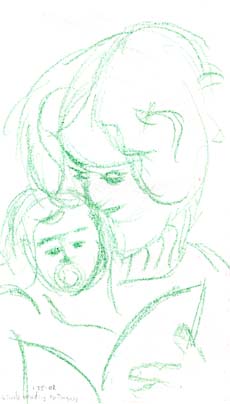
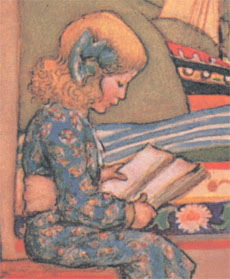
Girl Reading, detail from The Golden Staircase, by M. Dibdin Spooner
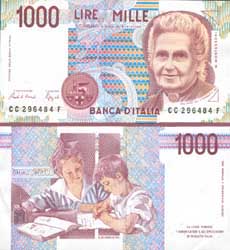
Maria Montessori, shown on Italian 1000 Lire note